
What is agentic AI for finance?
By MacrosLM Team · Reviewed by Damira Baigozha, ex-PwC Valuation & M&A Advisory Expert
Agentic AI for finance is software that uses autonomous AI agents to run entire financial workflows end to end, rather than just answering questions or moving data around. The word "agentic" carries real weight: an agent doesn't complete one step and wait for instructions. It plans, executes, validates its own work, handles the exceptions, and produces a finished result, coordinating across systems along the way.
The contrast that makes it concrete: ask a chatbot to reconcile an account and it tells you how. Give the task to an agent and it does the reconciliation, ingesting the data from each system, matching the records, surfacing the discrepancies, and handing back a workpaper, without an analyst opening a spreadsheet.
This is the category finance is moving into fast. Below is what agentic AI actually means, the architecture underneath it, how it differs from the automation finance teams already know, what a multi-agent system is, where it's being used, and what stays human.
How it differs from RPA and generative AI
"Agentic" gets attached to a lot of tools that aren't, so the distinction matters. There are three things it's often confused with:
- Rules-based automation (RPA) follows rigid if-then logic. It's fast at moving data through a predefined path, but it breaks the moment it hits an exception it wasn't scripted for. It moves data; it doesn't reason.
- Generative AI assistants (chatbots, copilots) answer questions and draft content. They're genuinely useful, but they leave the execution to you. They suggest the next step; they don't take it.
- Business intelligence tools surface dashboards, but they don't act on what they find.
Agentic AI combines three things into a single loop: perception (read the financial data), reasoning (work through a multi-step problem, including the exceptions), and action (execute the steps the task requires), while keeping an audit trail of what it did. When an invoice arrives, an agent doesn't just extract the numbers; it validates the amount against the contract, checks for duplicate payments, maps it to the right GL account, confirms the payment terms, and flags anything off. The progression is sometimes described as: GenAI generates content, AI agents execute tasks, and agentic AI orchestrates multiple agents to do the work together.
What's actually under the hood
The word "agent" hides real machinery. Recent surveys of the field converge on a common anatomy: a modern LLM-based agent is built from four modules, usually described as profiling (the role the agent plays), memory (state it carries across steps), planning (how it decomposes a goal), and action (the tools it can call). What separates an agent from a plain LLM query is persistence: the agent maintains state across steps, adapts its strategy based on intermediate results, and produces structured outputs that downstream processes can consume. A one-shot answer forgets everything; an agent remembers what it found in step three when it acts in step seven.
A handful of named design patterns do the heavy lifting, and they're worth knowing because they explain why agents can handle finance work that chatbots can't:
- ReAct (Reason + Act). The foundational pattern, introduced by Yao and colleagues in 2023. The agent interleaves reasoning steps with actions in a loop: it thinks about the next step, calls a tool or API, observes the result, then reasons again. Crucially, this produces an interpretable trace of why it did what it did, which matters enormously in finance where every conclusion has to be defended.
- Tool use. The agent calls external functions, databases, calculators, or document readers rather than trying to answer from memory. Toolformer (Schick et al., 2023) showed LLMs can learn to select and invoke tools on their own. In finance this is what lets an agent pull a figure from a filing or run a calculation instead of hallucinating one.
- Planning. Rather than reacting step by step, a planning agent decomposes a goal into a sequence of subtasks with dependencies up front, then executes. For structured, repeatable finance workflows this "plan-then-act" approach is often more efficient and more auditable than an open-ended reasoning loop.
- Reflection. The agent reviews and critiques its own output before finalizing it, a self-checking stage that improves accuracy on complex work.
- Multi-agent collaboration. Several specialized agents divide a large job (covered in detail below).
Two more components make these patterns usable for real financial work. Memory lets an agent retain institutional knowledge and intermediate findings across a long task. And grounding ties the agent's reasoning to authoritative data (ERP, filings, market data) so its outputs are accurate and auditable rather than plausible-sounding guesses.
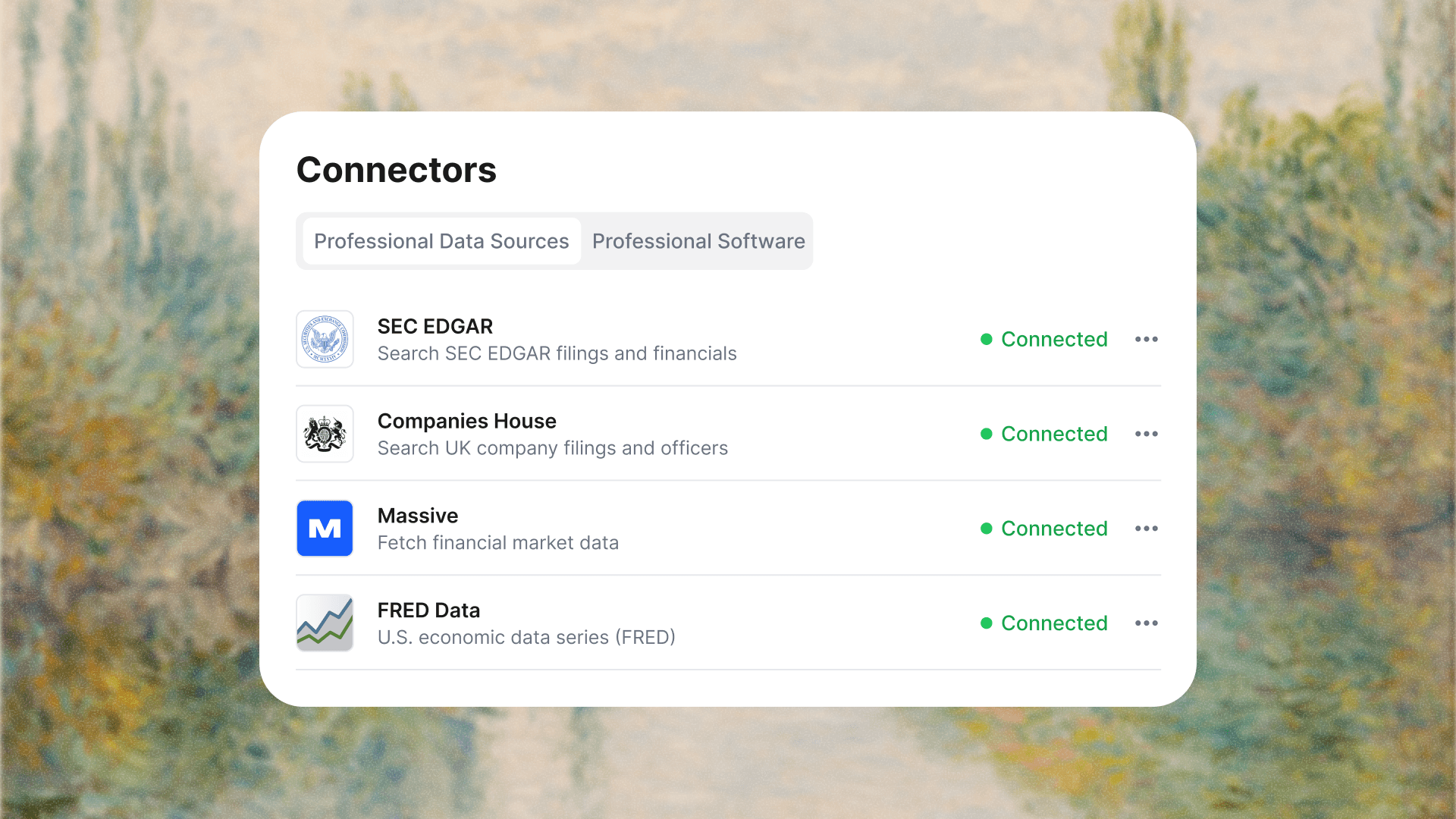
A 2026 academic survey of agentic AI in finance frames these — cognitive architecture, memory systems, planning frameworks, and communication protocols — as the core building blocks any serious financial agent needs.
What a multi-agent system is
The most capable agentic systems aren't one big agent trying to do everything. They're multi-agent: several specialized agents, each owning a piece of a larger workflow, that hand off tasks and share results, often coordinated by an orchestrating layer that sequences the whole job.
The reason is the same one that makes a team beat a generalist on complex work. Specialization brings accuracy and consistency to each part; coordination assembles the parts into a finished deliverable. One agent gathers and validates the evidence, another runs the analysis, another structures the output, another checks it. Each is good at its narrow job, and the system as a whole completes work no single step could.
Architecturally, this coordination takes a few recognized shapes. The most common in enterprise finance is orchestrator-worker (also called supervisor-based): a central orchestrator receives the task, breaks it into subtasks, routes each to the right specialist agent, and synthesizes the results. A related pattern, agent-as-tool, treats each specialist as a callable capability the orchestrator invokes on demand rather than as a fully autonomous actor. Agents can run in sequence (each builds on the last) or in parallel (independent analyses run at once) — parallel execution is what lets a risk system analyze transaction patterns, credit exposure, and market conditions simultaneously instead of one after another. Underneath, many production systems represent the whole workflow as a directed graph of steps with explicit interfaces and fallback paths, so the execution is repeatable and can be audited.
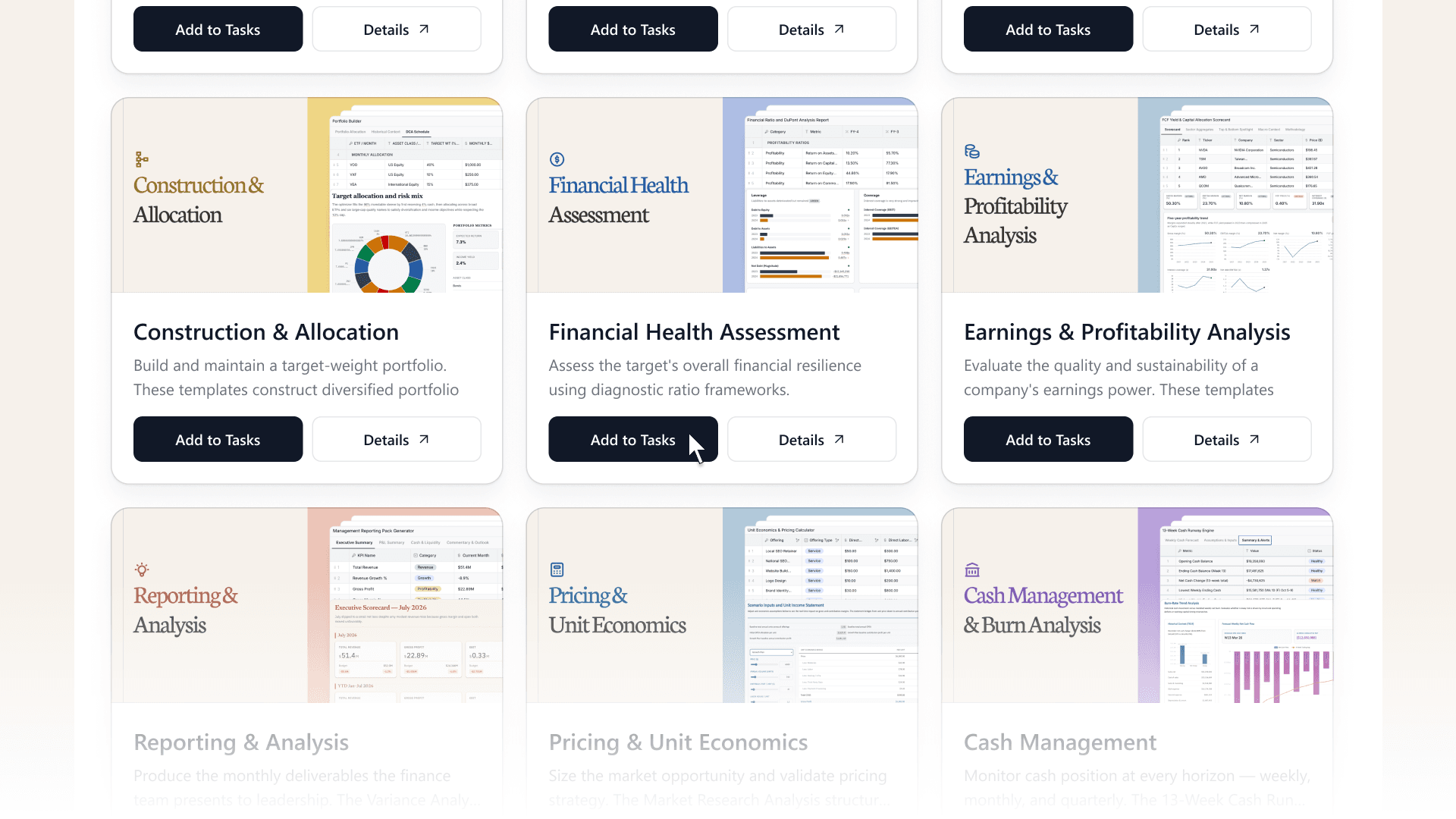
This is what a multi-agentic workspace like MacrosLM is built on: a project comes in, specialized agents handle the research, analysis, structuring, and review, and what comes back is a finished, citation-backed deliverable, with every figure traceable to the source it came from. The model mirrors how a real finance team divides labor, which is why it can take on work that single-prompt tools can't.
In practice, that means the agents run inside the workspace, not on your machine. You bring the files or connect the data sources — a data room, an ERP, SEC EDGAR — and the agents do the reasoning-heavy work there, handing back a deliverable for you to review. It isn't a bot that takes over your desktop or posts to your systems of record on its own; the autonomy is in doing the work, and the finished result comes to you for sign-off.
MacrosLM is built specifically for high-stakes financial work — audit, diligence, valuation, credit, and compliance. It runs on 100+ specialized agents backed by a library of 300+ skills, coordinated so each owns part of a workflow while the system assembles the finished result. Rather than leaning on a single general-purpose model, it uses a metamodel architecture that turns a firm's own policies and procedures into specialized small language models tuned to real enterprise data. Those models learn from a firm's workflows over time, adapting to its environment and standards so precision and consistency improve with each run. Every output is explainable, with clear reasoning traces grounded directly in the source documents, so the AI executes the work across large volumes of files and the professional provides the final judgment and sign-off.
A practical note from the research: multi-agent complexity is not free. Every reasoning loop and every agent call costs LLM calls, latency, and coordination overhead, and the literature is candid that teams should add agents only when specialization or parallelism genuinely improves the outcome. The known failure modes — agents looping, drifting from their assigned role, or miscoordinating — are real engineering challenges, not marketing footnotes. A well-built system is one where the architecture is matched to the actual workload, not maximized for its own sake.
Why finance is adopting it now
The adoption numbers are striking, and they're recent. Per a Wolters Kluwer CFO survey, 44% of finance teams will deploy agentic AI in 2026, a jump of more than 600% from the prior year. Gartner projects that 90% of finance functions will run at least one AI-enabled solution by 2026, and that by 2028 roughly 15% of day-to-day work decisions will be made autonomously by agentic AI. Goldman Sachs is already running production agents for transaction reconciliation, trade accounting, and client vetting, and across 2025 the world's largest banks announced well over a hundred agentic initiatives.
The reason finance specifically is leaning in: most finance-operations pain isn't slow data movement, which automation already solved. It's the reasoning-heavy, exception-laden, document-grounded work that used to require a person, reconciliations, close, diligence, compliance testing, exactly the work agents can now run. The vision some describe is the "10x" finance team, where a small number of people direct a set of AI co-workers to produce far more than headcount alone would allow.
Where it's used
Agentic AI shows up across the finance and accounting stack. A few representative areas, several of which we cover in depth:
- Month-end close and reconciliation — matching records across systems, surfacing discrepancies, drafting workpapers.
- Diligence and valuation — building a quality of earnings analysis, a DCF model, an EBITDA bridge, or net working capital normalization from a data room.
- Audit and controls — SOX control testing and journal entry testing across full populations.
- Compliance — KYC risk scoring and ongoing monitoring.
- Credit analysis — loan covenant compliance tracking and distress screening like the Altman Z-Score.
The common thread: each is a multi-step process that takes in messy source documents, reasons across them, and produces a defensible output. That's the shape of work agents do well.
The governance question: what stays human
Autonomy is the point, and also the risk. Agents that reason, act, and reach across systems create new exposure, which is why every serious treatment of agentic finance lands on the same answer: human oversight and an audit trail are non-negotiable. This isn't a limitation bolted on afterward; it's part of what makes agentic AI usable in finance at all.
The research literature names the specific technical risks that make this more than a platitude. Reliability decomposes into distinct problems — generalizability, calibration (does the agent know when it's uncertain), factuality, and social bias — each of which has to be managed for mission-critical use. Multi-agent systems add their own failure modes like looping and role drift. And the newest academic work on back-office automation flags that enterprise deployment is still held back by a lack of typed planning, evaluation metrics, and auditable execution paths. In other words, the governance problem is an engineering problem, and traceability is the answer to a real risk, not a compliance checkbox.
Two principles do the work. First, escalation to humans at the right moments — agents handle the routine and the mechanical, but the decisions carrying real consequence (a judgment call, a sign-off, an exception that doesn't have a clean answer) go to a person. Second, traceability — every figure an agent produces should link back to the source it came from, so the output can be reviewed, defended, and audited.
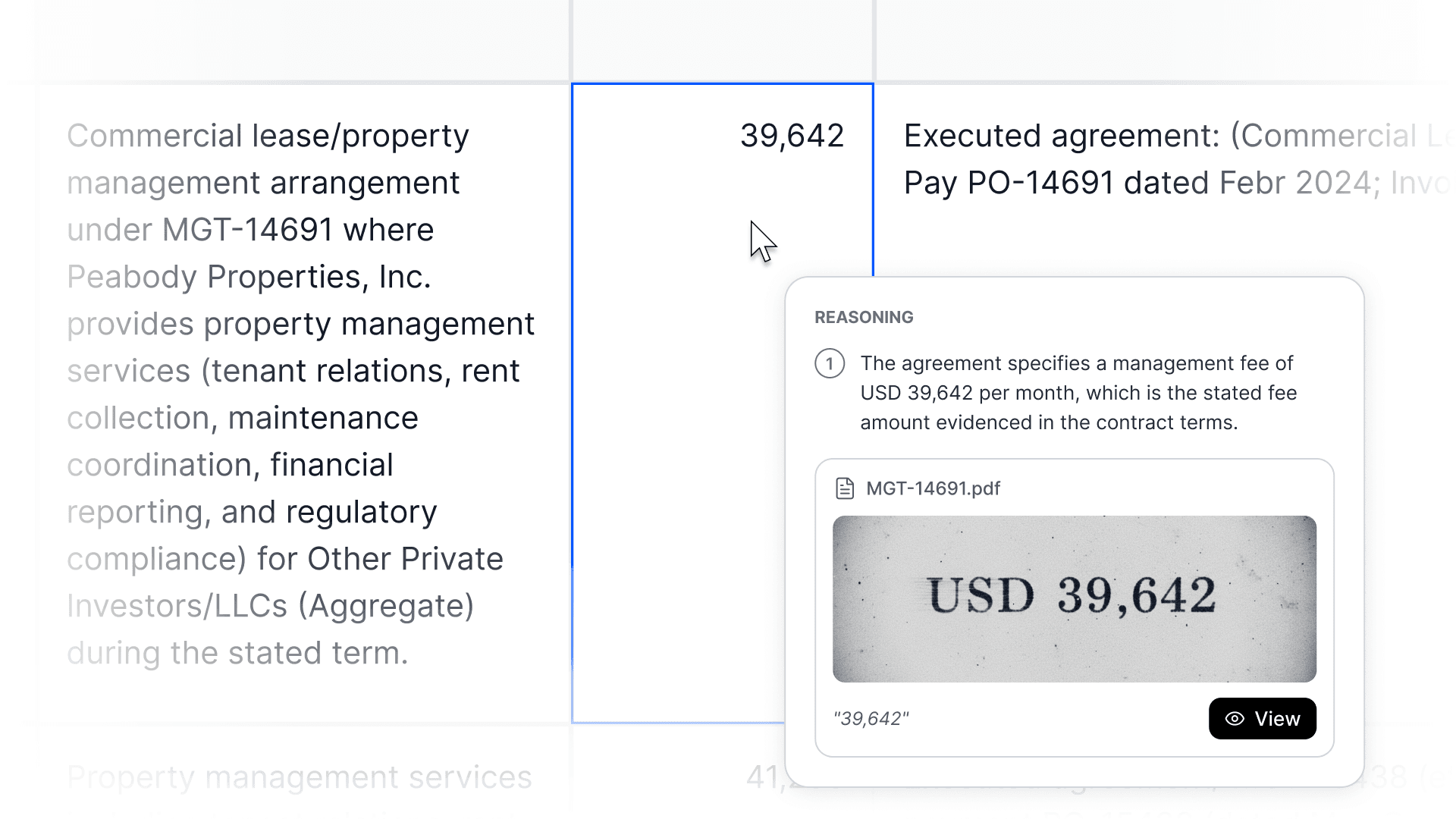
This matters more in finance than almost anywhere else, because the work is regulated and the conclusions get signed. The regulatory direction in 2026, from the PCAOB's attention to AI in audit to the EU AI Act classifying AI used in credit decisions as high-risk, all points the same way: the human stays accountable for the result no matter how capable the tooling.
A well-built agentic system is designed for exactly this. The AI does the work; the qualified professional checks it and owns the conclusion.
Bottom line
Agentic AI for finance is the shift from tools that assist to systems that do the work, autonomous agents that plan, execute, and validate complete financial workflows rather than answering one prompt at a time. Under the hood they combine planning, tool use, memory, and reasoning patterns like ReAct into a loop that produces an auditable trace. The most capable versions are multi-agentic: specialized agents dividing the labor the way a finance team does, coordinated by an orchestrator into a finished, traceable deliverable. Adoption is accelerating fast in 2026 because the work agents handle best, reasoning-heavy and document-grounded, is exactly what used to eat finance teams' hours. The constant is the human: oversight, escalation, and a full audit trail are what make autonomy safe to use, and the professional still owns the conclusion.
Sources
- Wolters Kluwer / CCH Tagetik — Finance leaders plan to increase agentic AI adoption by 6x — source for the 44%-by-2026 adoption figure.
- Gartner — 90% of Finance Functions Will Deploy at Least One AI-enabled Solution by 2026
- Gartner — 15% of day-to-day work decisions made autonomously by 2028
- Yao et al. — ReAct: Synergizing Reasoning and Acting in Language Models (ICLR 2023)
- Schick et al. — Toolformer: Language Models Can Teach Themselves to Use Tools (2023)
- CNBC — Goldman Sachs taps Anthropic's Claude to automate accounting, compliance roles
- Evident Insights — Banks go agentic — source for the 2025 bank agentic-initiative count.
This article is for general information. Deploying AI in financial workflows carries governance, data-security, and regulatory considerations that depend on your institution and jurisdiction, and should be evaluated with qualified professionals.
Frequently asked questions
- What is agentic AI for finance?
- Agentic AI for finance is software that uses autonomous AI agents to run entire financial workflows end to end — planning, executing, validating their own work, and handling exceptions — rather than just answering questions or moving data. Ask a chatbot to reconcile an account and it tells you how; give it to an agent and it does the reconciliation and hands back a workpaper.
- How is agentic AI different from RPA and generative AI?
- RPA follows rigid if-then rules and breaks on exceptions; generative AI assistants answer questions but leave execution to you; BI tools show dashboards but don't act. Agentic AI combines perception, reasoning, and action into one loop — it reads the data, works through the problem including exceptions, and executes across systems, keeping an audit trail.
- What is a multi-agent system?
- A multi-agent system uses several specialized agents, each owning part of a workflow, coordinated by an orchestrator that breaks the task into subtasks, routes each to the right specialist, and synthesizes the results. It mirrors how a finance team divides labor — one agent gathers evidence, another analyzes, another structures, another reviews.
- What stays human in agentic AI for finance?
- Human oversight and a full audit trail. Agents handle the routine work, but decisions carrying real consequence — a judgment call, a sign-off, an unclear exception — escalate to a person, and every figure links back to its source so the output can be reviewed and defended. Under the EU AI Act and PCAOB scrutiny, the human stays accountable for the result.
Reviewed by Damira Baigozha
ex-PwC Valuation & M&A Advisory Expert. Written by the MacrosLM editorial team.
View profile →