
Best AI for financial due diligence (2026)
By MacrosLM Team · Reviewed by Damira Baigozha, ex-PwC Valuation & M&A Advisory Expert
Financial due diligence has a volume problem. A mid-market deal can generate thousands of documents — financial statements, contracts, tax returns, board materials — and the deal team is expected to review all of it thoroughly, under a compressed timeline, with almost no margin for error. Internal teams commonly spend six weeks or more on the document review for a single investment, and external diligence often runs $50,000 or more, with complex deals well into six figures.
AI is reshaping that work, but not by replacing the deal team's judgment. It compresses the reading: extracting financials, tying the same figure out across the CIM and the tax return, flagging discrepancies, and surfacing risks so professionals reach the real questions faster. The catch is that "AI for due diligence" covers very different kinds of software — data rooms that store the documents, contract tools that extract legal risk, and financial engines that actually analyze the numbers — and buying the wrong layer is the most common and expensive mistake.
Match the tool to the job
"AI for due diligence" spans several different jobs. Pick the one you're solving:
What's actually eating your time? Pick the bottleneck — the tool category follows.
Virtual data room
Datasite · Ansarada · Intralinks
You need to host and run a secure, multi-bidder process. Datasite (the first VDR to launch an MCP server, April 2026), Ansarada, and Intralinks store the room, control permissions, redact at scale, and track bidder behavior. They hold and secure the documents rather than analyze the deal.
MacrosLM
Disclosure: MacrosLM is our own product. We've aimed to describe every alternative fairly and accurately, but read this comparison knowing where we sit.
MacrosLM is the multi-agentic AI workspace for high-stakes financial work, and financial due diligence is one of its core use cases. Rather than storing the data room or extracting clauses, it reads across the whole deal and produces the finished analysis — a quality-of-earnings first pass, an EBITDA bridge, a working-capital view, an IC-ready memo — with every figure traced to its source. One analyst covers what used to take a deal team, and the judgment stays with the analyst.
Pick a diligence agent, or create your own task. MacrosLM ships with 100+ expert-built agents and 300+ skills, organized into bundles by financial field — M&A & Diligence, Valuation, Audit & Accounting, Credit Analysis, FP&A, and more. For deal teams, the M&A & Diligence and Valuation bundles are the ones that matter: agents for the analysis that fills the nights before an IC meeting. You pick the agent for the work in front of you, or describe a task in plain language, then load the data room and set the scope. No prompt engineering required. Browse the diligence agents in the app →
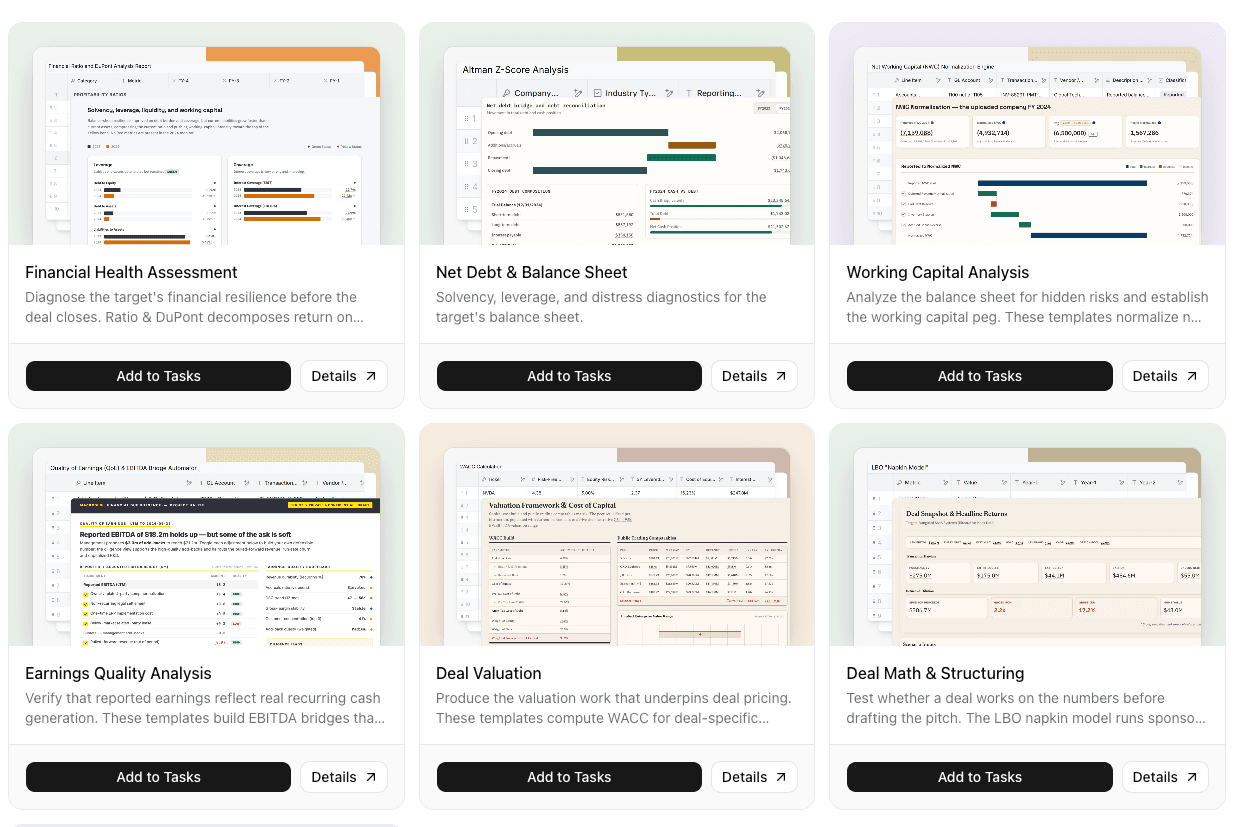
Built for the diligence work that eats the hours. The M&A & Diligence bundle covers the analysis a deal team grinds through, so you start from a built agent, not a blank workspace:
- Earnings Quality Analysis — verifies that reported earnings reflect real recurring cash generation, building the EBITDA bridge and add-back review that a QoE rests on.
- Working Capital Analysis — analyzes the balance sheet for hidden risks and establishes the working-capital peg, normalizing net working capital.
- Net Debt & Balance Sheet — solvency, leverage, and distress diagnostics for the target's balance sheet.
- Financial Health Assessment — diagnoses the target's financial resilience before the deal closes, with a Ratio & DuPont decomposition of return on capital.
- Deal Valuation — produces the valuation work that underpins deal pricing, computing WACC for the deal-specific cost of capital.
- Deal Math & Structuring — tests whether a deal works on the numbers before you draft the pitch, with an LBO napkin model that runs the sponsor economics.
- Deal Origination & Screening — builds the target or buyer pipeline for an M&A engagement, screening for acquisition candidates that fit the mandate.
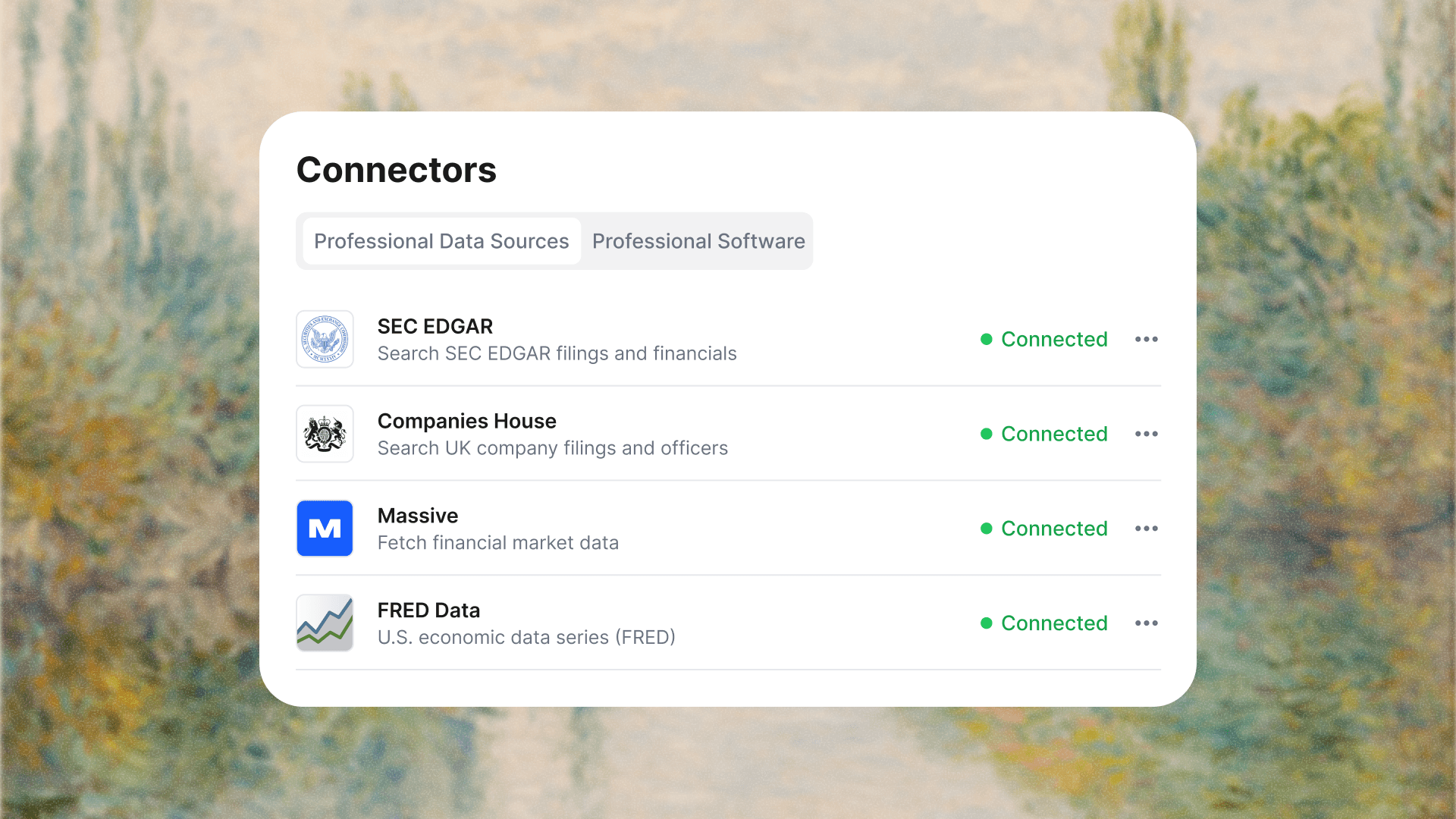
Reads the whole data room. Drop in up to 1M files at once — the CIM, audited financials, tax returns, contracts, scanned PDFs, spreadsheets — and MacrosLM reads every one in full and turns it into structured data. Sync live sources too: SEC EDGAR, FRED, Companies House, and market data for the numbers; NetSuite, Salesforce, and SharePoint for the systems your work lives in.
Cross-document tie-out, every figure sourced. The real value in FDD is reconciling the same number across the CIM, the financials, and the tax return, and flagging every discrepancy. MacrosLM does exactly that, and traces each figure to the exact page, cell, or clause it came from. Click any number and see the document behind it. If it can't point to a source, it won't put it in — which is what makes the output defensible to an IC or a lender rather than a black box.
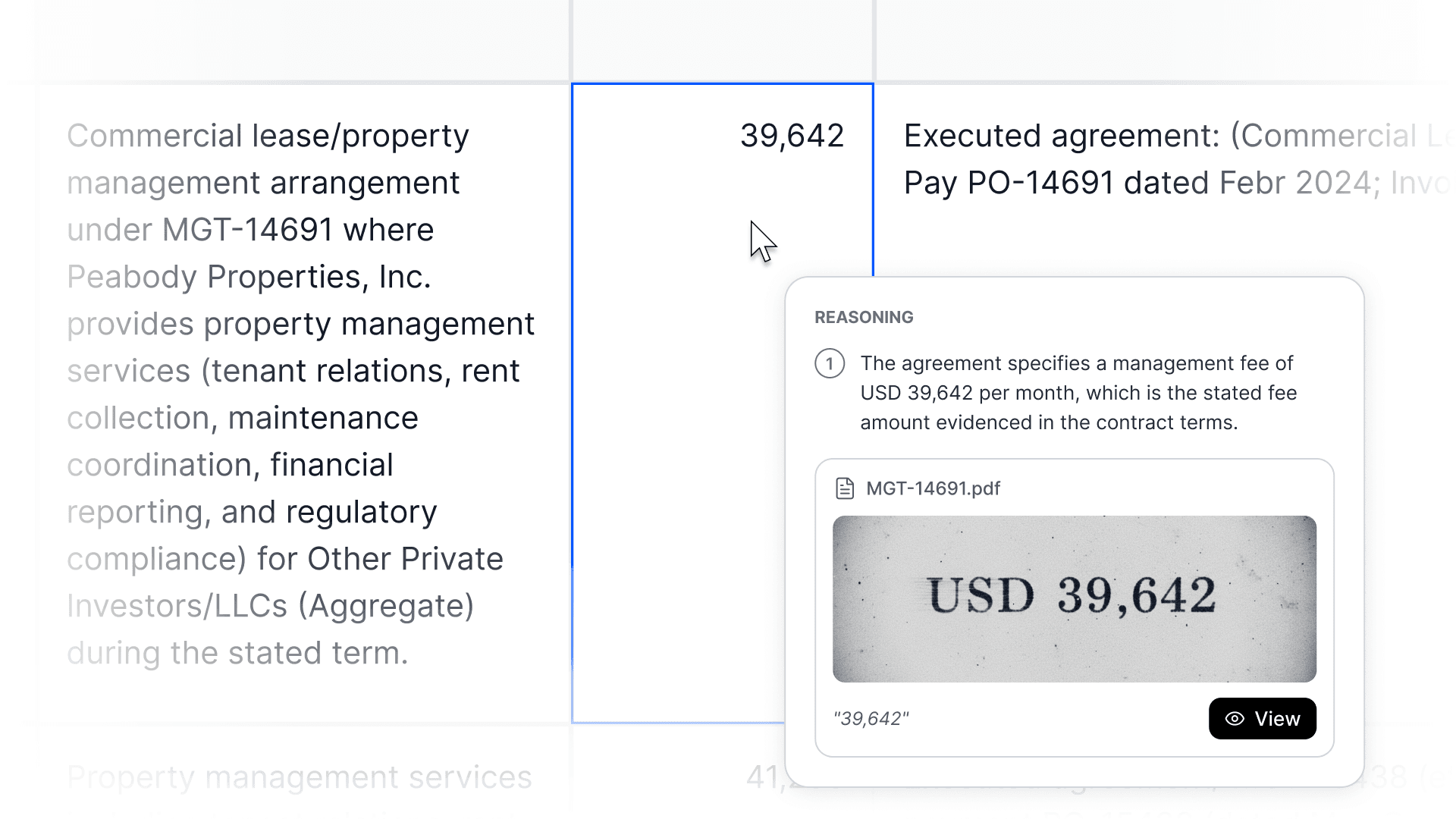
You stay in control. MacrosLM flags its assumptions and asks for your input, and you oversee every workflow in real time. AI generates the findings; the analyst makes the rulings, and owns the conclusion.
Output in your firm's format. MacrosLM learns your memo structure, model layout, logo, and colors from your own files, so an IC memo or QoE workpaper comes back in your house style with no reformatting. Export to live sheets, visuals, reports, and decks.
Security. SOC 2 Type II, GDPR and CCPA compliant, encrypted in transit and at rest, and your deal data never trains a model.
Best for: deal teams that want the QoE first pass, the EBITDA bridge, and the IC memo built, sourced, and review-ready — not just faster data extraction. Get started · Book a demo
Where each tool sits in due diligence
The alternatives
MacrosLM produces the financial analysis. The tools below solve adjacent problems — holding the data room, extracting legal risk, synthesizing large document sets, or pulling financials into a spreadsheet — and most serious deal teams run one of them alongside a financial engine.
Datasite, Ansarada, and Intralinks — the virtual data room
Datasite is a dominant VDR that has evolved into an AI-first deal-lifecycle platform, with AI indexing, categorization, redaction, and bidder-engagement tracking that flags buyer concerns from reviewer behavior. It announced an MCP server in April 2026 — the first VDR to do so — letting AI assistants work on live deal content inside the room under its permissions and audit logs. Ansarada emphasizes AI redaction and bidder-behavior prediction; Intralinks (DealVision) embeds diligence and Q&A workflows. All three manage and secure the data room; none of them analyzes the deal for you. Best for: running a secure, multi-bidder process with tight regulatory oversight.
Kira (Litera) and Luminance — contract review
Long-established contract-analysis tools that extract key provisions — change-of-control, assignment, term — with high accuracy on pretrained clauses. Their value is catching the single clause that costs money post-close. These are legal-DD tools: they extract and flag contract risk, but neither does the financial analysis a QoE requires. Best for: legal DD on contract-heavy deals.
Hebbia, Rogo, and Brightwave — document synthesis and agents
Hebbia's Matrix applies LLMs to dense deal materials — CIMs, transcripts, management presentations — to answer questions at speed; Rogo and Brightwave run agentic, multi-step research and drafting over large document sets. Best for: synthesizing and querying a big document set fast, and increasingly drafting from it. Strongest at surfacing and summarizing; the financial workpaper and the sign-off remain the analyst's.
Dili — financial data extraction
Dili specializes in extracting financial data from unstructured documents like audited financials and tax returns, converting PDFs into clean Excel with normalized line items and saving days of manual data entry during a QoE. It's the closest neighbor to a financial engine, but it's built to extract and structure the data rather than produce the finished, reasoned analysis on top of it. Best for: fast, accurate financial data extraction.
Finsider, Embark, and Aprio — QoE automation
A newer wave of QoE-specific tools automates the spreading of historicals, flags EBITDA adjustments, and drafts a quality-of-earnings analysis. Best for: accelerating the QoE itself — the stage that overlaps most with MacrosLM's financial-analysis lane.
What AI can't do in financial DD
An honest guide has to say where the line is. AI genuinely compresses the document-heavy work, but it does not replace three things, and any vendor implying otherwise should raise a flag.
It doesn't replace a signed quality of earnings report. AI can do a QoE first pass — tying EBITDA out across the CIM, financials, and tax return, flagging discrepancies, and scrutinizing each add-back for whether it survives a sale — so you reach a defensible number before commissioning a formal engagement. But the signed QoE opinion your lender and reps-and-warranties insurer rely on still comes from your provider, who now starts from an organized, pre-flagged position instead of a cold data room.
It doesn't make the judgment calls. Valuation judgment, negotiation strategy, seller conversations, and relationship assessment stay human-led. The useful rule: AI generates findings, humans make rulings.
It doesn't close the deal. Software stores the room, reads the documents, and surfaces the questions. The judgment, the legal review, and the QoE work still belong to you and your advisors.
The point isn't that AI is limited; it's that it moves your scarce hours off grinding through PDFs and onto the analysis that actually decides the deal.
What to look for
- Source citations on every figure. Non-negotiable for financial DD. Un-cited AI output can't be defended to an investor or a lender. This is also where the categories separate: a tool that cites is doing analysis; one that only summarizes is not.
- Cross-document tie-out. The real value is reconciling the same figure across the CIM, the financials, and the tax return, and flagging every discrepancy. Check the tool does this, not just single-document summaries.
- Handles messy, real data rooms. Deal rooms arrive unsorted, with scans and mixed formats. Accuracy claims usually assume machine-readable PDFs; confirm performance on the documents you actually receive.
- Security and data handling. For deal data, look for SOC 2 Type II, encryption in transit and at rest, and an explicit guarantee your data never trains public models.
- Integration with your stack. FDD outputs should flow into your model and CRM. Check it fits the VDR, Excel, and deal tools you already run.
How to choose
Match the tool to the layer you're missing. A secure, multi-bidder process → a VDR (Datasite, Ansarada, Intralinks). Legal contract review → Kira or Luminance. Synthesizing a big document set → Hebbia or an agent (Rogo, Brightwave). Extracting financials → Dili. The financial analysis itself — tying out the numbers, the QoE first pass, the EBITDA bridge, the IC memo — is where a financial engine like MacrosLM fits, alongside QoE-automation tools (Finsider, Embark, Aprio). Most serious teams run more than one layer.
Then test on a real (non-confidential) deal that looks like yours. Judge it on whether the output is sourced, defensible, and something you'd put in front of an investment committee, not on the feature list.
Bottom line
There's no single best AI for financial due diligence, because the tools work at different layers: VDRs hold and run the room, contract tools extract legal risk, and financial engines like MacrosLM produce the sourced analysis of the numbers. What separates the ones worth buying is a traceable evidence layer, real cross-document tie-out, serious security, and honesty about the line AI doesn't cross — the signed QoE, the judgment, and the deal itself, which stay with you and your advisors. Find your bottleneck, buy the layer that fixes it, and test on real work.
Sources
- Dealroom — Due Diligence Process: 6 Steps + 6-Week Timeline — source for the ~6-week middle-market document-review timeline.
- DataRooms.org — How Much Does Due Diligence Cost? Ranges & Benchmarks — source for the $50K-and-up, six-figures-for-complex-deals cost range.
This article reflects the deal-technology landscape as of 2026, which changes quickly. Capabilities, pricing, and certifications should be verified directly with each vendor. Nothing here is a substitute for professional financial, legal, or tax advice in a transaction.
Frequently asked questions
- What is the best AI for financial due diligence?
- There's no single best tool — they work at different layers. Virtual data rooms like Datasite hold and secure the room; contract tools like Kira extract legal risk; extraction tools like Dili pull financials into Excel; and financial engines like MacrosLM produce the sourced analysis — the QoE first pass, EBITDA bridge, working-capital view, and IC memo. Match the tool to the layer you're missing.
- Can AI do a quality of earnings analysis?
- AI can do a QoE first pass — tying EBITDA out across the CIM, financials, and tax return, flagging discrepancies, and scrutinizing add-backs — so you reach a defensible number before commissioning a formal engagement. But the signed QoE opinion your lender and reps-and-warranties insurer rely on still comes from your provider.
- What can't AI do in financial due diligence?
- Three things: it doesn't replace the signed QoE report, it doesn't make the judgment calls (valuation, negotiation, seller conversations stay human-led), and it doesn't close the deal. The rule of thumb: AI generates findings, humans make rulings.
- What should you look for in an AI tool for financial due diligence?
- Source citations on every figure, real cross-document tie-out (reconciling the same number across the CIM, financials, and tax return), the ability to handle messy real data rooms with scans and mixed formats, serious security (SOC 2 Type II, encryption, no training on your data), and integration with your VDR, Excel, and deal stack.
Reviewed by Damira Baigozha
ex-PwC Valuation & M&A Advisory Expert. Written by the MacrosLM editorial team.
View profile →