
Best AI contract review tools for finance and legal ops (2026)
By MacrosLM Team · Reviewed by Damira Baigozha, ex-PwC Valuation & M&A Advisory Expert
Contract review is where finance and legal ops overlap, and where the hours quietly disappear. Before anyone can decide whether a credit agreement's covenants are safe, whether a target's contracts survive a change of control, or whether a vendor MSA carries hidden liability, someone has to read every page and pull out what matters. That reading is slow, expensive, and error-prone — a single agreement can take a few hours to review properly, and modern AI tools cut first-pass review time substantially. That's why contract review has become one of the most-searched legal-AI use cases.
The catch is that "AI contract review" is not one product. The market has split in two: incumbent contract-lifecycle-management (CLM) platforms that were built as workflow engines and later added AI, and a newer class of genAI-native tools built to reason across documents from scratch. On top of that split, the tools serve very different jobs — routing and storing contracts, extracting clauses across thousands of documents for M&A, autonomously redlining, or reading contracts as part of a financial analysis. Buying for the wrong job is the classic mistake.
This guide is organized by the job you actually need done, starting with the one closest to finance work: reading contracts as part of the deal, the credit file, or the diligence, where the terms have to connect to the numbers.
Match the tool to the job
Most "best contract AI" confusion comes from comparing a CLM platform to a due-diligence engine to a drafting assistant as if they competed. They don't — they do different jobs. Pick the one you're solving:
Contract review isn't one job. Pick what you actually need done — the tool category follows.
Agentic finance workspace
MacrosLM
You need the terms to feed a financial question — do these covenants hold, does this agreement change the credit risk, does this contract survive the acquisition. An agentic finance workspace reads the contracts alongside the financials and produces a sourced deliverable, not a redline. MacrosLM is built for this; it doesn't replace legal sign-off.
MacrosLM — contract review tied to the numbers
Disclosure: MacrosLM is our own product. We've aimed to describe every alternative fairly and accurately, but read this comparison knowing where we sit.
MacrosLM is the multi-agentic AI workspace for high-stakes financial work, and contract review sits inside that rather than beside it. Where a legal tool reads a contract to manage or redline it, MacrosLM reads it to answer a financial question: do these covenants hold, does this agreement change the credit risk, does this contract survive the acquisition, what does this term do to the model.
You drop in the agreements alongside the financials — up to 1M files at once — and MacrosLM runs the review through purpose-built agents rather than a general chat. It ships with 100+ expert-built agents and 300+ skills, and the ones that matter for contract review sit across its Audit, Compliance, and Credit bundles:
- Contract Clause and Term Extraction — pulls the key clauses and terms out of an agreement and flags what's unusual, missing, or unfavorable.
- Debt Agreement Terms Extractor — abstracts the terms of credit and loan agreements, the ones a finance team has to live by.
- Loan Covenant Compliance Tracker — tests covenants against the numbers and monitors compliance, paired with the Debt Capacity & Refinancing Scenario Modeler to size the remaining headroom.
- Lease Abstraction and Lease Agreement Risk Assessment — abstract lease terms straight from the agreements and score the risk in them.
- Board Minutes Extraction and Analysis and Related Parties Transactions — surface resolutions and related-party dealings from minutes and agreements.
- Sanctions & PEP Screening and Corporate Governance Compliance Assessment — put the counterparty and the agreement in their regulatory context.
You pick the agent for the work in front of you, or describe a task in plain language — no prompt engineering — and the output is a finished, sourced deliverable in your firm's format, not a chat answer.
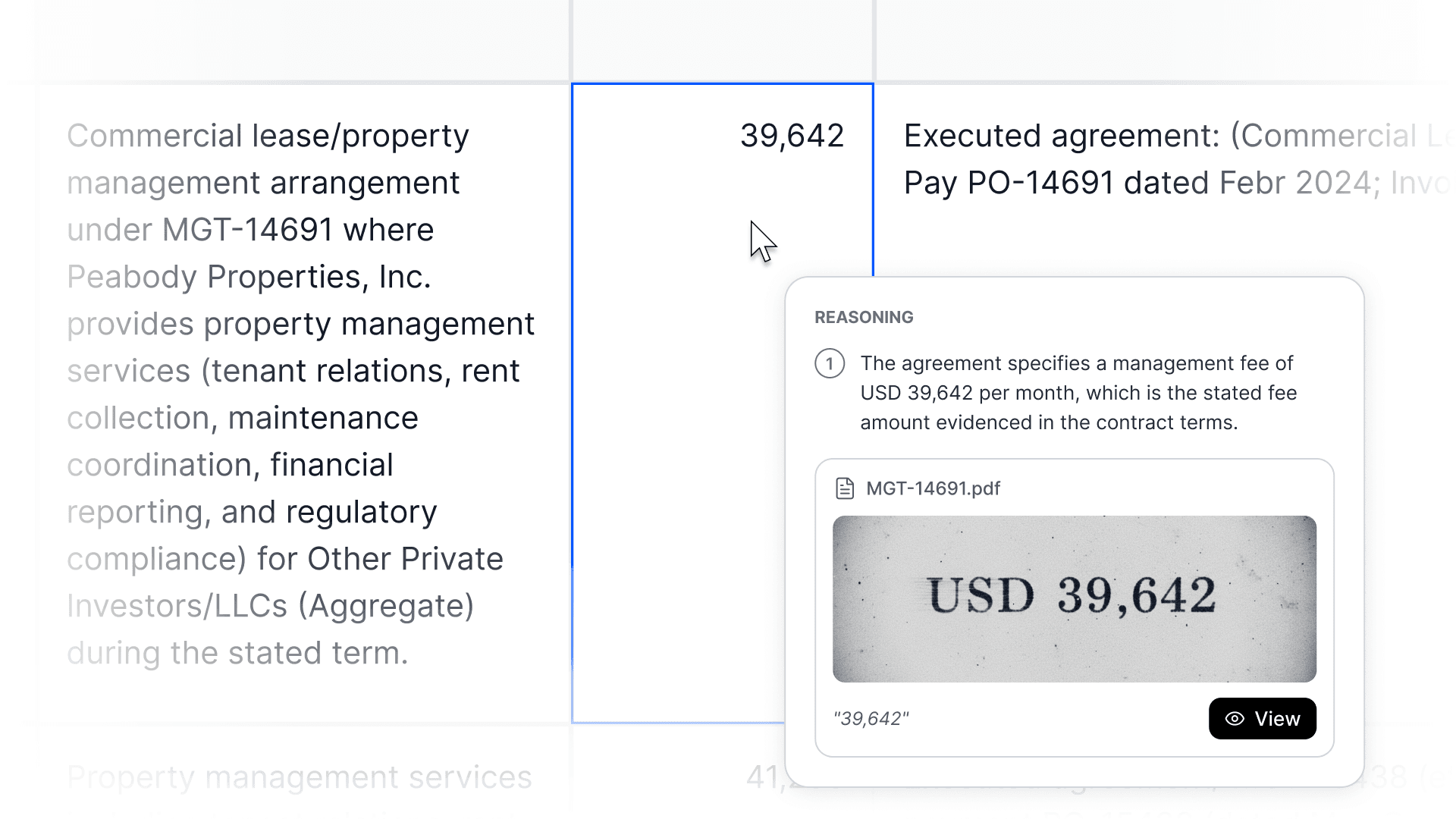
What makes it fit finance and legal ops is evidence-based reasoning — every extracted term or covenant links back to the exact clause, and if it can't cite a source, it won't state it — and terms tested against the numbers, like a covenant checked against capacity or a change-of-control clause read in the context of the deal. It also taps legal and regulatory sources (Legal Cases, OpenSanctions, CFPB Complaints, FFIEC) to put an agreement in context, is SOC 2 Type II, GDPR, and CCPA compliant, and never trains a model on your documents.
Beyond contract review it runs the rest of the finance work too — FP&A, valuation, audit, credit, and diligence — on multiple frontier models (Claude, GPT, Gemini) plus its own, NDI.
Best for: finance and deal teams, and the legal-ops functions beside them, who need contract terms read as part of the credit, diligence, or valuation work. It doesn't replace a lawyer's legal judgment or a signed legal opinion, and it isn't a contract-lifecycle system of record. Get started · Book a demo
The alternatives
MacrosLM reads contract terms as part of the financial analysis. The tools below solve adjacent problems — extracting clauses in bulk, running the lifecycle, clearing routine review, or drafting in Word — and a finance or legal-ops team often runs one of them alongside a financial workspace.
Kira and Luminance — bulk M&A due-diligence extraction
Kira (part of Litera) was one of the first tools built for large-scale legal due diligence, with machine-learning models trained on millions of real clauses. It finds change-of-control, assignment, termination, and IP provisions across entire portfolios in hours rather than weeks. It's an extraction engine — strong on the pile of contracts, less suited to day-to-day management. Luminance competes here with autonomous review and Auto Redline. Best for: law firms and corporate-development teams running transactions.
Ironclad, LinkSquares, and Evisort — the full contract lifecycle
Ironclad is the enterprise CLM default: contract creation, approval routing, obligation management, audit trails, and an AI-powered searchable repository. Its AI review is competent, but its real strength is workflow automation and repository management at scale, for in-house teams managing thousands of active contracts. LinkSquares and Evisort sit in the same layer. Best for: in-house legal ops that need a system of record and high-volume workflow.
LawGeex — routine pre-signature review against a playbook
LawGeex automates the routine first pass, comparing incoming contracts to a standardized playbook and flagging what's off. Built for in-house teams with high volumes of standard agreements, it clears the routine so lawyers spend their time on the exceptions. Best for: teams with high volumes of standardized contracts and a defined playbook.
Spellbook — drafting inside Word
Spellbook brings GPT-powered drafting and review into Microsoft Word, suited to teams that live in Word and want AI where they already work. Best for: lawyers who draft and redline primarily in Word.
What AI can't do in contract review
The honest part, and it holds across every tool here. AI compresses the reading; it doesn't carry the legal judgment.
It doesn't replace legal sign-off. On standard contracts with a well-configured playbook, modern tools reach high accuracy — but that last stretch, and any unusual, high-stakes, or bespoke agreement, still needs a lawyer. Every serious guide says the same: the AI produces a first pass, a qualified professional signs off.
It doesn't make the judgment call. Whether to accept a risk, how hard to negotiate a term, what a clause means for this specific deal — these are human decisions. AI surfaces the findings; people make the rulings.
It's only as good as the source. An extracted term you can't trace to the clause is a term you have to re-check by hand. Traceability isn't a nice-to-have — it's what makes the speed worth anything.
What to look for
- Source citations on every finding. The finding has to link to the clause it came from, or it can't be defended. This is where real analysis separates from a dressed-up summarizer.
- Clause identification and risk flagging. It should name specific clause types (indemnification, limitation of liability, termination) and flag what's unusual, missing, or unfavorable — not just restate what the contract says.
- Fit to the job. A due-diligence engine won't run your CLM, and a CLM won't do a bulk M&A extraction. Match the category to the work.
- Security and data residency. For contracts, look for SOC 2, encryption in transit and at rest, and, where relevant, EU data residency and a guarantee your documents don't train public models.
- Integration. The tool should connect to where your documents and systems already live.
How to choose
Match the tool to the job. For bulk M&A extraction across thousands of contracts, a due-diligence engine like Kira or Luminance. For the full contract lifecycle and a system of record, a CLM like Ironclad. For routine pre-signature review, a playbook tool like LawGeex. For drafting in Word, Spellbook. And when the contract terms have to feed the financial analysis — the credit file, the deal, the valuation — that's where an agentic finance workspace like MacrosLM fits, next to the rest of your financial due diligence stack. Many teams run more than one.
Then test on your own contracts. Every credible vendor offers a proof-of-concept; run it on real, non-confidential agreements and judge the output on whether it's accurate, sourced, and something you'd act on.
Bottom line
There's no single best AI contract review tool, because the tools do different jobs. CLM platforms like Ironclad manage the lifecycle, due-diligence engines like Kira and Luminance extract across thousands of contracts, playbook tools like LawGeex clear the routine, and agentic workspaces like MacrosLM read the terms as part of the financial analysis and tie every finding to its source. What separates the good ones is traceability, clause-level risk flagging, the right fit for your job, and honesty about the line AI doesn't cross — the legal judgment and the sign-off, which stay human. Find your job, match the category, and test on your own contracts before you buy.
Sources
- Thomson Reuters — How AI enhances contract lifecycle management — AI across the contract stages, and why human oversight stays in the loop.
- Thomson Reuters — Step-by-step guide to M&A legal due diligence — reviewing anti-assignment and change-of-control provisions during diligence.
- AICPA & CIMA — System and Organization Controls (SOC) suite of services — the standard-setter's own reference for SOC 2.
This article reflects the contract-review technology landscape as of 2026, which changes quickly. Capabilities, pricing, accuracy figures, and certifications should be verified directly with each vendor. MacrosLM is our product; the alternatives are described in good faith for comparison. Nothing here is legal advice or a substitute for professional legal, financial, or regulatory judgment.
Frequently asked questions
- Can AI review contracts accurately enough to rely on?
- On standard contracts with a well-configured playbook, leading tools reach high accuracy and cut first-pass review time substantially. Unusual, high-stakes, or bespoke agreements still need a lawyer's review, and every finding should be traceable to its source clause before you act on it.
- What's the difference between a CLM and an AI contract review tool?
- A CLM like Ironclad manages contracts across their lifecycle — creation, routing, approval, storage — with AI review added on. A dedicated review or due-diligence tool like Kira focuses on reading and extracting terms. They solve different problems, and many teams run both.
- How is MacrosLM different from a legal contract tool?
- Legal tools read a contract to manage, redline, or store it. MacrosLM reads it to answer a financial question — testing covenants against capacity, reading a change-of-control clause in the context of the deal, and tying every term back to its source. It's built for finance and deal teams, not as a legal system of record, and it doesn't replace legal sign-off.
- Is AI contract review secure for confidential agreements?
- The serious tools offer SOC 2, encryption in transit and at rest, and role-based access; some add ISO 27001 or EU data residency. For sensitive contracts, verify the specific certifications and confirm your documents aren't used to train public models before uploading.
Reviewed by Damira Baigozha
ex-PwC Valuation & M&A Advisory Expert. Written by the MacrosLM editorial team.
View profile →