
Best AI tools for credit analysis (2026)
By MacrosLM Team · Reviewed by Damira Baigozha, ex-PwC Valuation & M&A Advisory Expert
Credit analysis is a document problem before it's a judgment problem. Before an analyst can assess whether a borrower can service its debt, someone has to extract the financials from PDFs and tax returns, spread them into a standard format, calculate the ratios, read the loan agreement, and write the memo. That mechanical layer is where the hours go, and it's exactly what AI now compresses. The strongest tools take messy borrower documents to a full credit assessment in minutes.
But "AI for credit analysis" covers several different jobs, and the biggest mistake is buying a tool built for a different one. The clearest divide: consumer credit scoring (high-volume, model-driven approve/decline) is not the same as commercial and institutional credit analysis (relationship-based, document-heavy, judgment-led). They need different tools, and this guide is about the commercial side.
Match the tool to the job
Commercial credit spans intake to monitoring. Pick the part that's costing you time:
What's actually eating your time? Pick the bottleneck — the tool category follows.
Extraction & spreading
Ocrolus · Validis
Your time goes to keying borrower financials, tax returns, and bank statements into a standard spread. Ocrolus and Validis specialize in that intake and standardization; MacrosLM also reads and structures the file as the first step of its analysis.
MacrosLM
Disclosure: MacrosLM is our own product. We've aimed to describe every alternative fairly and accurately, but read this comparison knowing where we sit.
MacrosLM is the multi-agentic AI workspace for high-stakes financial work, and commercial credit analysis is one of its core use cases. Rather than just spreading documents or scoring a file, it reads across the borrower's financials, tax returns, and loan documents and produces the finished credit deliverable — the analysis and the memo — with every figure traced to its source. One analyst produces what used to take a team, and the credit judgment stays with the analyst.
Pick a credit agent, or create your own task. MacrosLM ships with 100+ expert-built agents and 300+ skills, organized into bundles by financial field — Credit Analysis, M&A & Diligence, Valuation, Audit & Accounting, FP&A, and more. For credit teams, the Credit Analysis bundle is the one that matters: agents for the work that fills an analyst's day, from spreading through the memo. You pick the agent for the work in front of you, or describe a task in plain language, then upload the borrower's documents and set the scope. No prompt engineering required. Browse the credit agents in the app →
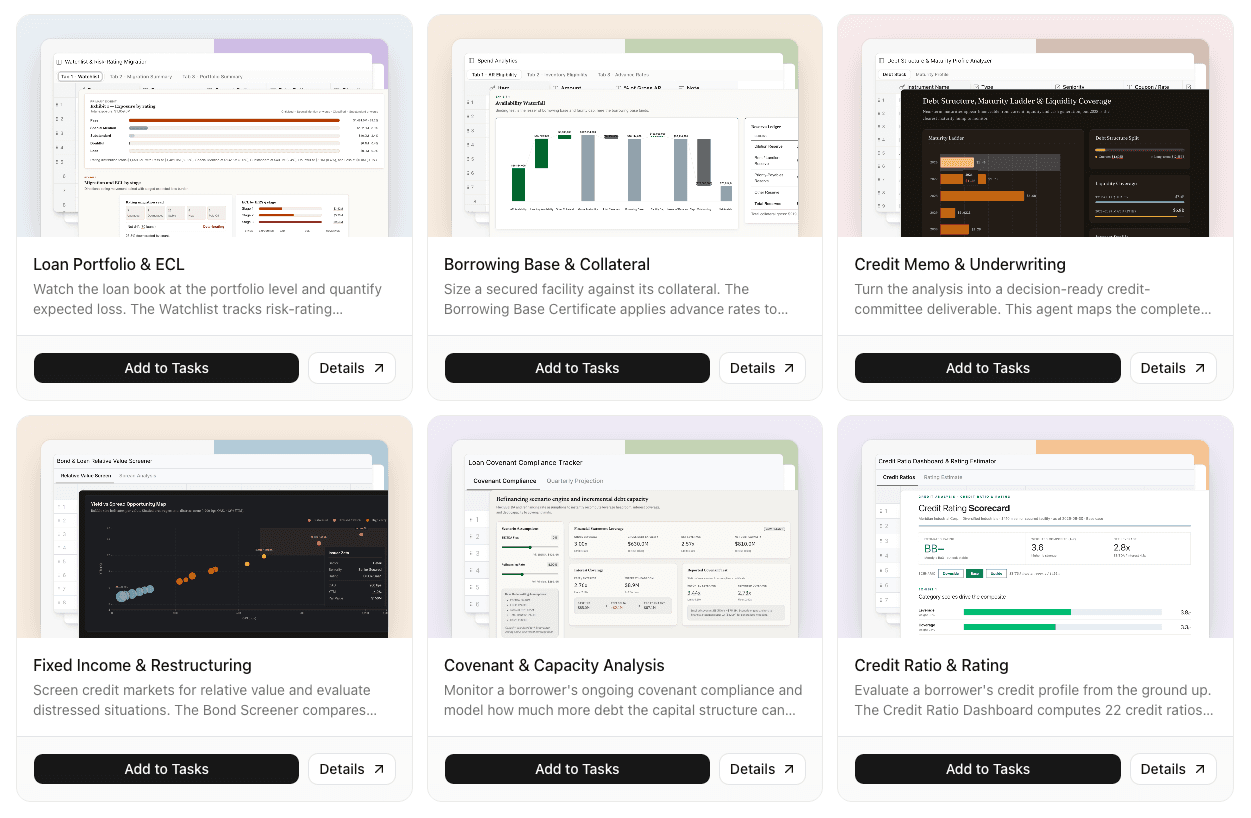
Built for the credit work that eats the hours. The Credit Analysis bundle covers the analysis a credit team grinds through, so you start from a built agent, not a blank workspace:
- Credit Ratio & Rating — evaluates a borrower's credit profile from the ground up; the Credit Ratio Dashboard computes 22 credit ratios and produces a rating estimate.
- Credit Memo & Underwriting — turns the analysis into a decision-ready, credit-committee deliverable, mapping the complete underwriting picture.
- Covenant & Capacity Analysis — monitors a borrower's ongoing covenant compliance and models how much additional debt the capital structure can carry.
- Borrowing Base & Collateral — sizes a secured facility against its collateral, applying advance rates through the Borrowing Base Certificate.
- Loan Portfolio & ECL — watches the loan book at the portfolio level and quantifies expected loss, with a watchlist that tracks risk-rating migration.
- Fixed Income & Restructuring — screens credit markets for relative value and evaluates distressed situations, with a bond screener for opportunity mapping.
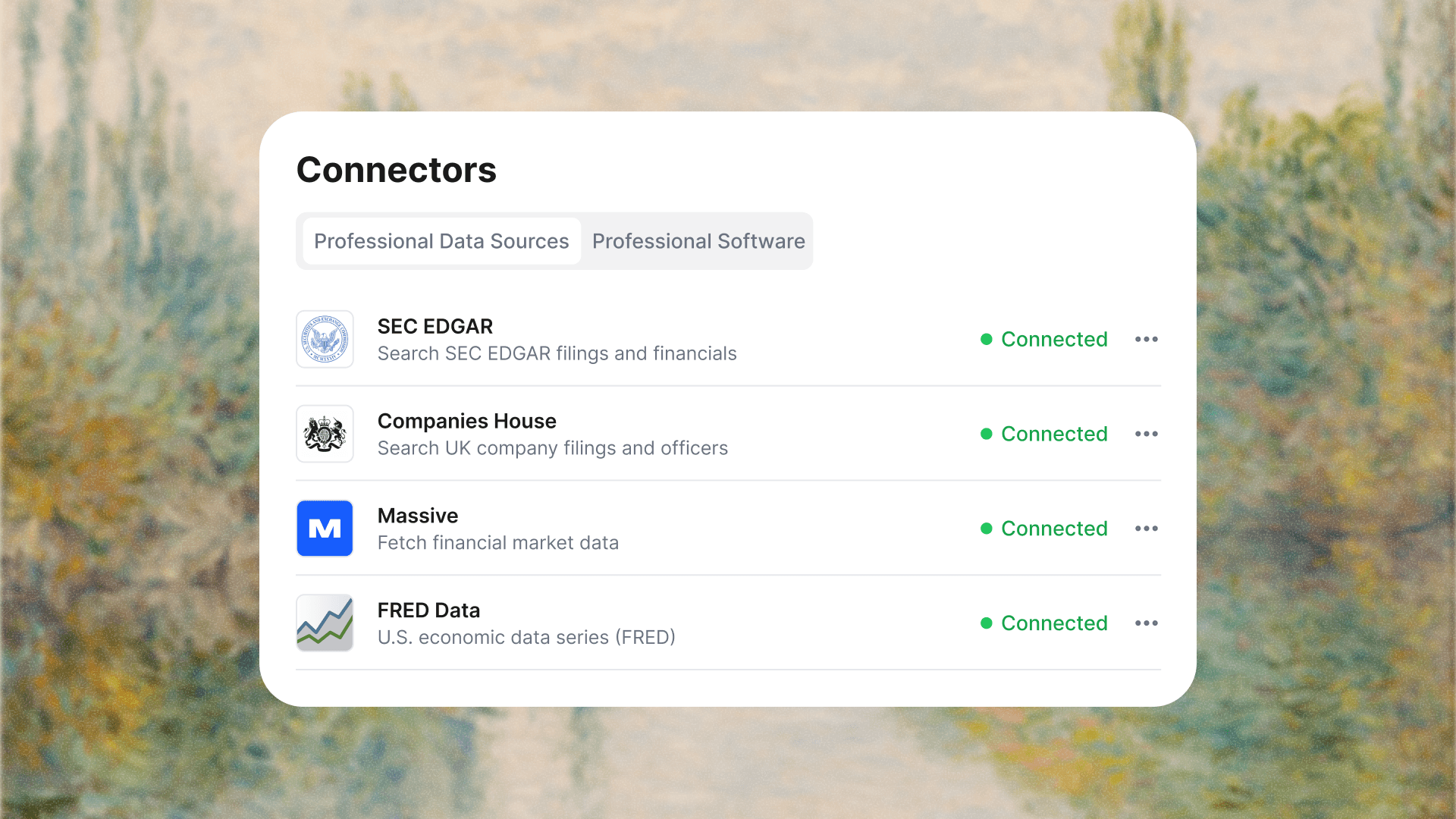
Reads the whole file. Drop in up to 1M files at once — financials, tax returns, loan agreements, bank statements, scans — and MacrosLM turns them into structured data. Sync live sources too: SEC EDGAR, FRED, Companies House, and market data; NetSuite, Salesforce, and SharePoint.
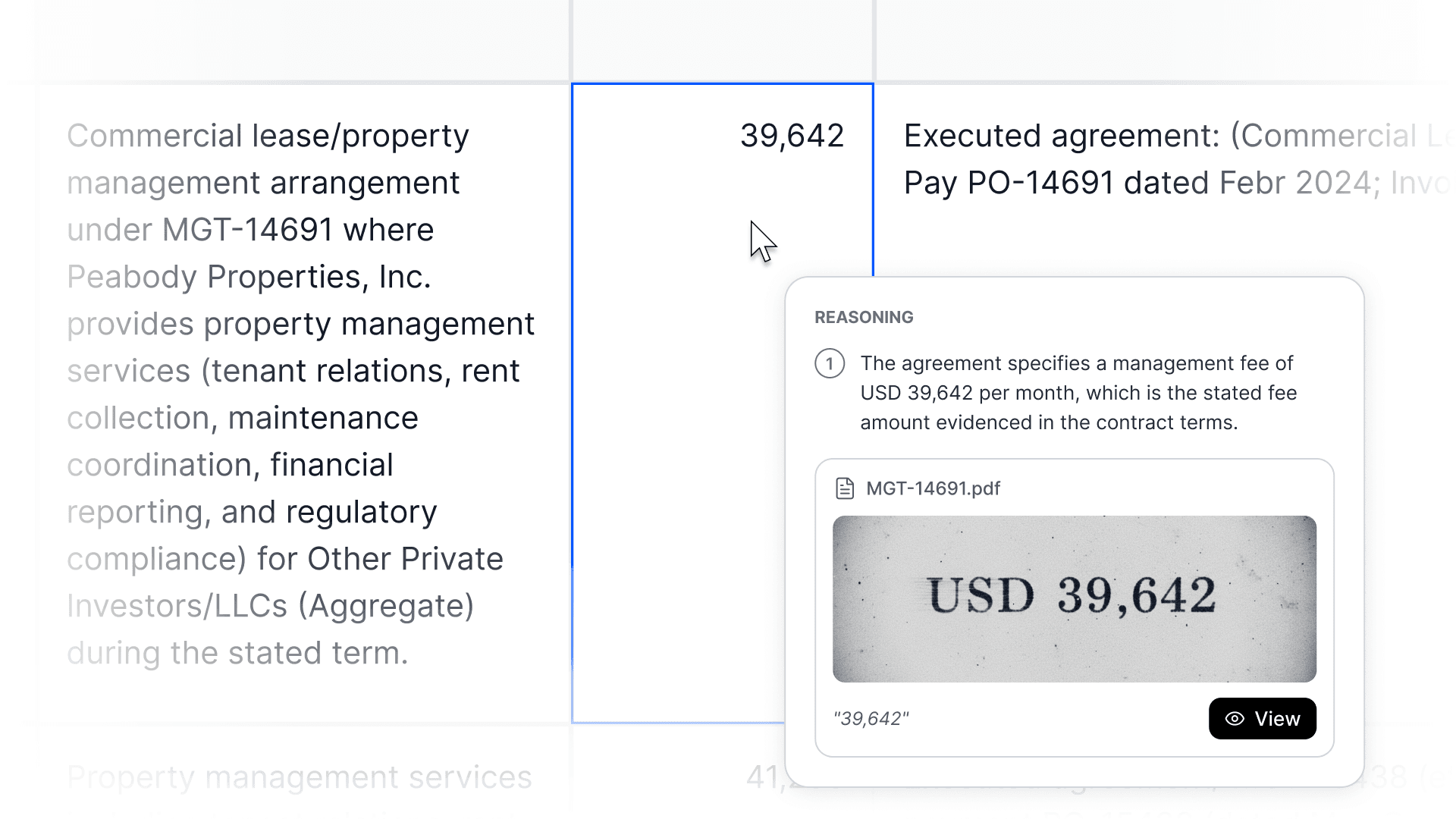
Every ratio shows its work. Click any figure in the memo and MacrosLM traces it to the line items behind it, on the exact page or cell. If it can't point to a source, it won't put it in — which is what makes the memo defensible to a credit committee and to an examiner.
You stay in control. MacrosLM flags its assumptions and asks for your input in real time. AI does the spreading and analysis; the analyst makes the credit decision and owns it.
Output in your firm's format. MacrosLM learns your memo structure, model layout, logo, and colors, so the credit memo comes back in your house style. Export to sheets, visuals, reports, and decks.
Security. SOC 2 Type II, GDPR and CCPA compliant, encrypted in transit and at rest, and your borrower data never trains a model.
Best for: commercial and private-credit teams that want the analysis and memo built, sourced, and review-ready — not just documents spread or a score returned. Get started · Book a demo
Where each tool sits in the workflow
The alternatives
MacrosLM produces the credit analysis and memo. The tools below solve adjacent problems — extracting and spreading the file, running the full underwriting workflow, standardizing on Moody's models, writing the memo, or monitoring a portfolio — and many lenders run one alongside an agentic workspace.
Ocrolus and Validis — extraction and spreading
The intake layer: turning borrower documents into a standard spread. Ocrolus is one of the largest document-AI vendors; Validis pulls structured data straight from accounting systems. Best for: killing manual data entry — a building block the rest of the workflow sits on.
Crediflow, nCino, Abrigo, and Numerated — end-to-end commercial platforms
The loan-origination and lending platforms that run the whole process: intake, spreading, memo, approval routing, and portfolio monitoring, with integrations to core banking and CRM. Crediflow is AI-native; nCino and Abrigo are established LOS platforms adding AI; Numerated leans into borrower-facing digital workflows. Best for: one system of record for the commercial-lending workflow end to end.
Moody's CreditLens — the credit lifecycle
Spreading, ratings, and monitoring backed by Moody's risk data and models, with standardized processes across teams and regions. There's also Moody's Credit Memo for the write-up. Best for: larger institutions that want Moody's models and a structured lifecycle; implementation is heavier than lighter tools.
Aloan — credit memo automation
A newer memo generator built around document analysis, with examiner-ready citations on every figure and deployment alongside an existing LOS. Best for: community and regional lenders whose bottleneck is specifically the memo. This is the lane that overlaps most with MacrosLM's analysis-and-memo output.
Hebbia and OakNorth — monitoring and credit intelligence
Hebbia synthesizes unstructured data (legal agreements, news) with agentic reasoning to flag risk — covenant issues, for example — before it shows up in lagging financials; OakNorth focuses on portfolio monitoring. MacrosLM covers this from the analysis side — its Loan Portfolio & ECL work, re-run on a schedule (daily or quarterly), re-scores the book and flags what changed. Best for: watching a book for emerging risk.
Zest AI and FICO — consumer decisioning (a different problem)
Decisioning engines built for high-volume retail approve/decline, optimized for a score and fair-lending compliance — Zest emphasizes explainability and reason codes; FICO's platform is the incumbent rules engine. They don't spread tax returns or write a middle-market memo. Match the tool to your lending type — the commercial and consumer worlds don't cross over.
What to look for
- Explainability and a traceable audit trail. In regulated lending this is non-negotiable, and it's getting stricter under regimes like the EU AI Act. Every credit output should link to the data behind it; a score or memo you can't trace is a liability. Look for page-level evidence pointers, not just a number.
- Commercial vs. consumer fit. Confirm the tool is built for your lending type. The two don't cross over.
- Depth of analysis. Beyond extraction: does it actually compute leverage, DSCR, cash-flow, covenant, and capacity, or just pull data?
- Integration. It should connect to your loan origination system, core banking, CRM, and data providers. Isolated tools force manual re-entry.
- Human judgment stays central. The best tools automate spreading and analysis and route the credit decision to the lender. AI accelerates the analyst; it doesn't replace credit judgment, policy control, or sign-off, and no serious vendor claims it does.
How to choose
Start with your bottleneck. Data entry from borrower documents → a spreading tool (Ocrolus, Validis). The whole commercial workflow and system of record → an LOS platform (Crediflow, nCino, Abrigo, Numerated). Moody's models and lifecycle → CreditLens. The memo specifically → Aloan or MacrosLM. High-volume consumer approve/decline → a decision model (Zest, FICO). Watching the book for emerging risk → a monitoring tool (Hebbia, OakNorth). And if it's producing the credit analysis and memo itself — defensible and sourced — that's where an agentic workspace like MacrosLM fits. Many institutions run more than one layer.
Then test on a real (non-confidential) borrower file and judge the output on whether it's sourced, defensible, and something you'd put in front of a credit committee.
Bottom line
There's no single best AI tool for credit analysis, because the work spans intake, decisioning, analysis, and monitoring, and consumer and commercial lending need different tools entirely. Spreading tools handle intake, decision models score consumer volume, end-to-end platforms run the commercial workflow, monitoring tools watch the book, and agentic workspaces like MacrosLM produce the finished, sourced analysis and memo. What separates the good ones is a traceable evidence layer, real analytical depth, the right commercial-or-consumer fit, and a design that keeps credit judgment with the human. Find your bottleneck, match the category, and test on a real file.
This article reflects the credit-technology landscape as of 2026, which changes quickly. Capabilities, integrations, and compliance features should be verified directly with each vendor. Nothing here is a substitute for professional credit, lending, or regulatory judgment.
Frequently asked questions
- What are the best AI tools for credit analysis?
- There's no single best tool, because the work spans intake, decisioning, analysis, and monitoring — and consumer and commercial lending need different tools. Spreading tools handle intake, decision models score consumer volume, end-to-end platforms run the commercial workflow, monitoring tools watch the book, and agentic workspaces like MacrosLM produce the finished, sourced analysis and memo.
- What's the difference between consumer and commercial credit analysis tools?
- Consumer credit scoring is high-volume, model-driven approve/decline optimized for a score and fair-lending compliance (Zest AI, FICO). Commercial and institutional credit analysis is relationship-based, document-heavy, and judgment-led — spreading financials, computing ratios, reading loan agreements, and writing a memo. The tools don't cross over; match the tool to your lending type.
- What should you look for in an AI credit analysis tool?
- Explainability and a traceable audit trail (page-level evidence pointers, not just a number), the right commercial-vs-consumer fit, real analytical depth (leverage, DSCR, cash-flow, covenant, and capacity — not just extraction), integration with your loan origination system and core banking, and a design that keeps the credit decision with the lender.
- Can AI replace credit analysts?
- No. The best tools automate the mechanical layer — spreading documents, computing ratios, drafting the memo — but credit judgment, policy control, and sign-off stay with the analyst, who owns the decision. In regulated lending, explainability and human accountability are non-negotiable and getting stricter under regimes like the EU AI Act.
Reviewed by Damira Baigozha
ex-PwC Valuation & M&A Advisory Expert. Written by the MacrosLM editorial team.
View profile →